
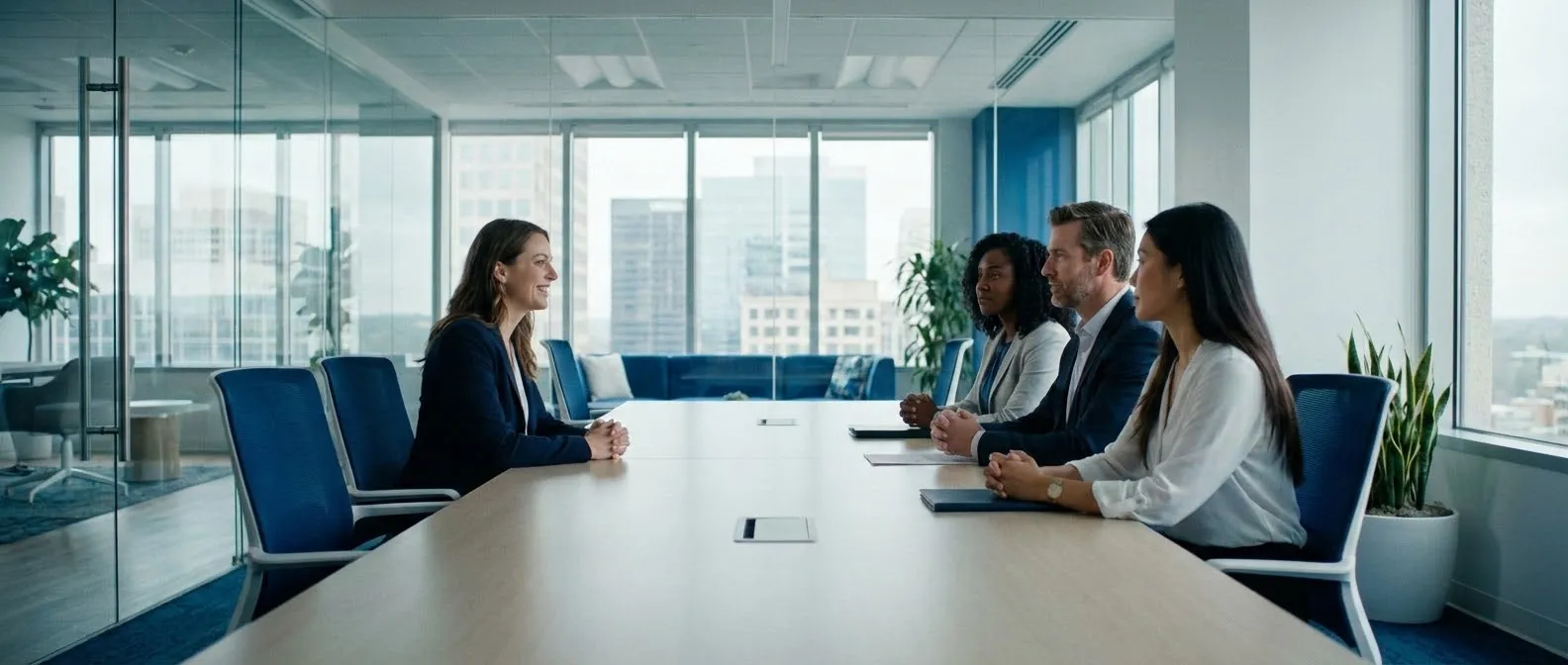
Why Panel Interviews Are Different (And Why That's Actually Good News)
Walking into a room with multiple interviewers staring back at you can feel like facing a jury. But here's what most candidates don't realize: panel interviews actually work in your favor once you understand their dynamics.
34% of organizations now use panel interviews as a standard part of their hiring process, with adoption exceeding 60% in technology, healthcare, and finance sectors 1. Unlike one-on-one interviews where a single person's bias can determine your fate, panels distribute decision-making power across multiple stakeholders.
The research is clear: structured panel interviews improve hiring accuracy by 20-30% compared to traditional interviews, and diverse panels reduce bias by approximately 25% 2. This means companies using panels are often more committed to fair evaluation—which benefits well-prepared candidates.
Pro Tip
Panel interviews typically last 45-90 minutes with 2-4 interviewers. The longer format gives you more opportunities to demonstrate your value across different competencies.
Understanding Who's in the Room
Before you can succeed in a panel interview, you need to understand what each person is looking for. Modern panels typically include a mix of roles, each with distinct priorities:
The Hiring Manager
The hiring manager is usually the primary decision-maker and cares most about:
- Can you do the job and deliver results?
- How quickly you'll ramp up
- Your problem-solving approach and prioritization
- How you'll fit the team's working style
To impress them: Use STAR answers with clear metrics. Spell out impact: "We reduced incident volume by 30% over six months." Show how you manage trade-offs, ambiguity, and stakeholder expectations.
HR / Talent Acquisition
HR focuses on the bigger picture:
- Culture and values alignment
- Conflict resolution and communication style
- Diversity, inclusion, and fairness indicators
- Past behavior as a predictor of future behavior
When HR asks a question, emphasize how you work with different personalities, handle difficult situations professionally, and embody company-like values such as integrity, respect, and ownership.
Team Lead or Peer Interviewers
These colleagues will work with you daily and typically assess:
- Depth of relevant technical or domain skills
- Pragmatic problem-solving and judgment
- How easy you'll be to collaborate with
- Ownership mentality versus "that's not my job" attitudes
Adjust your answers by including concrete tools, methods, or frameworks you've used. Emphasize collaboration ("We paired with product to...") rather than lone-hero stories.
Senior Leaders (When Present)
If a VP or executive joins the panel, they're evaluating:
- Strategic thinking and big-picture awareness
- Commercial, customer, or mission impact
- Long-term potential and leadership behaviors
With senior leaders in mind, occasionally zoom out: link your examples to revenue, cost, risk, or customer outcomes. Show you understand the organization's direction and market context.
The Eye Contact Rotation Technique
One of the most common mistakes candidates make is talking only to the person who asked the question—or worse, addressing only the most senior-looking person in the room. This is a major red flag that signals poor awareness and can alienate key decision-makers.
The Proven Pattern
Use this simple but effective approach:
1. Start with the questioner Look directly at the person who asked the question as you begin your answer. This shows focus and respect.
2. Share your answer with the whole panel After your first sentence or two, briefly sweep your gaze to other panelists for a second or two each, then naturally return to the original questioner.
3. Keep it natural, not robotic Think of eye contact as you would in a group of friends: you look at whoever is speaking, but everyone feels included.
4. Land your conclusion strategically When you finish an answer, make eye contact with the main decision-maker (often the hiring manager) as you deliver your final sentence—unless the dynamic clearly suggests someone else.
Common Mistake
- If one panelist looks disengaged (looking away, closed posture), don't ignore them. A short glance plus a phrase like "and from a team perspective..." can re-engage them and show your awareness.
Virtual Panel Interview Adjustments
For video panel interviews:
- Look at the camera when delivering key points so everyone feels you're speaking to them
- Glance at faces periodically to read reactions
- Keep your camera at eye level with framing from mid-torso up so your posture and gestures are visible
- Good lighting in front of you with a neutral background
Researching Your Panelists Before the Interview
Career coaches consistently recommend looking up interviewers on LinkedIn and online—it's not intrusive, it shows professionalism and preparation 3.
Step 1: Get the Names
Ask the recruiter or coordinator directly: "Could you share the names and roles of the people on the panel so I can prepare properly?"
Note their titles (HRBP, Engineering Manager, Product Lead)—this tells you what each person likely cares about.
Step 2: Research Each Panelist
For each person, look for:
- Role and scope: What do they own? (e.g., "Head of Customer Success—EMEA")
- Career path: Internal promotion, external hire, technical or commercial background
- Posts, talks, podcasts: Topics they care about (data, customer experience, people development)
- Common ground: Same university, city, volunteer interests—useful for light rapport
Step 3: Prepare Tailored Questions
Create one or two questions per panelist based on your research:
- For a team lead: "I saw your team recently rolled out the new CRM integration—how did that change your workflows?"
- For HR: "I noticed the company recently expanded parental leave—how has that impacted the culture?"
- For the hiring manager: "Based on the team's current roadmap, what would success look like in the first six months?"
Handling Multiple Questions and Interruptions
Panel interviews can feel chaotic: overlapping questions, follow-ups, and time pressure. Here's how to stay in control:
When Several People Ask Questions at Once
Use this three-step approach:
1. Pause and clarify "There were a couple of great questions there. Let me make sure I've got them right: first about X, then about Y—is that correct?"
2. Structure your answer out loud "I'll start with how I handled X, then come back to your question on Y."
3. Stay concise on each part Panels are very time-sensitive. Answer the core of each question, then stop and ask, "Would you like more detail on any part of that?"
When You're Interrupted Mid-Answer
- Don't fight the interruption—stop, smile briefly, and listen
- You can say: "Happy to come back to the last point, but let me address your question first."
- If redirected ("Could you focus more on the metrics?"), adjust without defensiveness
When Questions Have Multiple Sub-Parts
This is common: "Tell us about a time you led a project, what the challenges were, what you'd do differently, and how you managed stakeholders."
- Quickly note the parts if you have a notepad
- Use a mini-signpost: "Sure. I'll walk through the project briefly, then the main challenges, then what I'd do differently, and finally how I managed stakeholders."
- If you forget one part, add: "And to your last point about what I'd do differently..."
When Panelists Disagree
If panelists openly disagree in front of you:
- Stay neutral—do not take sides
- Acknowledge both angles: "I see how both perspectives show up in practice. In my last role, we handled that by..."
Body Language That Commands the Room
Body language is scrutinized even more closely in panel interviews because several people are observing at once.
Before You Sit Down
- Enter with upright posture, controlled pace, and a small, genuine smile
- Offer a firm but not crushing handshake if appropriate
- When you sit, keep your back against the chair or slightly forward, feet flat or crossed at ankles, shoulders relaxed
During the Interview
- Open posture: Avoid crossed arms or hunched shoulders; keep hands visible, resting on the table or your lap
- Moderate gestures: Use hand gestures to emphasize key points. Sudden, sharp movements look defensive; fidgeting suggests anxiety
- Facial expression: Neutral-positive baseline with occasional smiles at appropriate moments
- Active listening: Nod occasionally when others speak, maintain focus on the speaker
Reading Their Body Language
- Panelist leaning in, nodding, smiling = interest; you can go deeper on that topic
- Frowning or looking confused = clarify briefly: "Does that make sense, or should I unpack the approach a bit more?"
- Someone seems disengaged = pull them in: "From a [their function] perspective, an important element was..."
The 7 Mistakes That Sink Panel Interview Candidates
Avoid these common errors that hurt otherwise strong candidates:
Panel Interview Don'ts
- **Talking only to one person** - Focusing just on the lead interviewer or most senior person while ignoring others is a major red flag
- **Rambling, over-long answers** - With multiple interviewers, time goes quickly. Long, unfocused answers reduce time for good questions
- **Sounding over-rehearsed** - Memorizing scripts instead of using frameworks makes you rigid and less responsive to follow-ups
- **Weak company research** - Showing up without a clear grasp of the organization, products, or role is often fatal in panels
- **Not tailoring to different panelists** - Giving the same generic answer regardless of who asked wastes the advantage of multiple perspectives
- **Negative talk about past employers** - Comments linger because several people hear and later compare notes
- **Poor follow-up** - Not sending personalized thank-you notes to each panelist misses an easy opportunity to stand out
Your Panel Interview Preparation Checklist
One Week Before
- [ ] Confirm the names and roles of all panelists
- [ ] Research each panelist on LinkedIn and Google
- [ ] Prepare 1-2 tailored questions per panelist
- [ ] Review the job description and identify likely topics for each role
- [ ] Prepare 5-7 STAR stories that can be adapted to different questions
The Day Before
- [ ] Review your research notes on each panelist
- [ ] Practice eye contact rotation with a friend or family member
- [ ] Plan your outfit (professional, neutral colors)
- [ ] Prepare your questions to ask at the end
- [ ] Test any technology if it's a video interview
Interview Day
- [ ] Arrive 10-15 minutes early
- [ ] Bring copies of your resume for each panelist (if in-person)
- [ ] Bring a notepad and pen
- [ ] Take a few deep breaths before entering
- [ ] Smile and greet each panelist individually
After the Interview
- [ ] Send personalized thank-you emails to each panelist within 24 hours
- [ ] Reference something specific from your conversation with each person
- [ ] Reiterate your interest and key value proposition
Turning Panel Anxiety Into Your Advantage
93% of candidates report nervousness before interviews, with panel interviews amplifying stress due to the "on trial" feeling of facing multiple evaluators 4. But here's the reframe: panels give you more opportunities to connect with different people and demonstrate different competencies.
Think about it:
- In a one-on-one, if you don't click with the interviewer, you're out
- In a panel, you have multiple chances to build rapport
- Different panelists may appreciate different aspects of your experience
- Diverse panels are statistically more likely to evaluate you fairly
Organizations with diverse interview panels are 25% more likely to hire candidates who excel long-term 5. This means the panel format, while intimidating, often leads to better outcomes for qualified candidates.
How AI Can Help You Prepare
Modern AI tools can significantly accelerate your panel interview preparation:
- Generate role-specific questions for practice based on the job description
- Run mock panel scenarios with different interviewer personas
- Get feedback on your STAR stories for clarity and impact
- Research companies and panelists more efficiently
- Draft personalized follow-up emails for each panelist
Tools like HiredKit's AI Interview Coach can simulate panel dynamics, helping you practice managing multiple lines of questioning and maintaining composure under pressure.
Pro Tip
When using AI for practice, specify the roles of your simulated panelists (HR, hiring manager, team lead) to get realistic question variety and practice tailoring your responses.
The Bottom Line
Panel interviews test not just your qualifications but your ability to read a room, adapt your communication style, and build rapport with multiple stakeholders simultaneously—all skills you'll need on the job.
The candidates who succeed treat panel interviews as a strategic opportunity:
- They research each panelist and understand their priorities
- They use eye contact rotation to engage the entire room
- They tailor their answers to different roles
- They stay concise and structured under pressure
- They follow up thoughtfully with personalized messages
With structured panel interviews showing 20-30% better accuracy in predicting job performance, companies are investing in this format because it works. By mastering these techniques, you're not just passing an interview—you're demonstrating the exact collaborative skills that make you valuable on day one.
References
- [1]Zirtual Industry Survey (2024). Panel Interview Adoption Statistics 2024
- [2]Journal of Applied Psychology / LinkedIn Research (2024). Structured Interview Effectiveness and Bias Reduction
- [3]LinkedIn Career Coaches Survey (2025). Best Practices for Interviewer Research
- [4]JDP/Asker Survey (2025). Candidate Interview Anxiety Statistics 2025
- [5]4 Corner Resources / LinkedIn Research (2024). Diverse Panel Interview Outcomes