
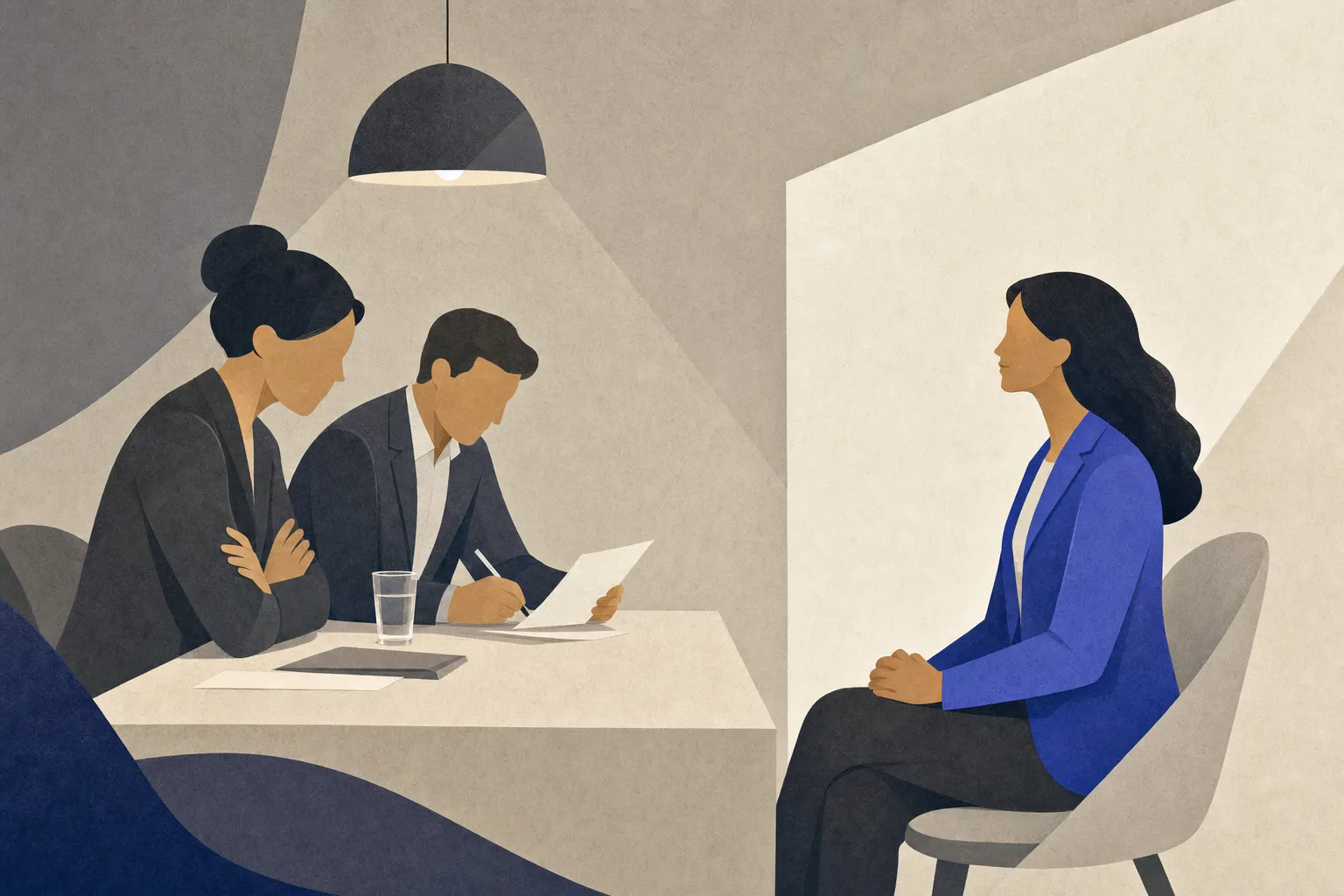
How to Handle a Stress Interview
To handle a stress interview, slow down on purpose: pause before every answer, breathe, and reframe each hostile tactic as a test of composure rather than a personal attack. A stress interview is a deliberately adversarial format — rapid-fire questions, interruptions, long silences, pushback, and curveballs — engineered to see how you behave under pressure, not whether you know the "right" answer. The single most important thing to understand about how to handle a stress interview is that your delivery is being graded more than your content. The interviewer who cuts you off mid-sentence has usually already read your resume. What they're measuring now is whether you stay calm, stay coherent, and stay likeable when the floor tilts.
This matters because the stakes are real and the nerves are nearly universal. A JDP survey found that 93% of Americans have experienced job-interview anxiety1, and a 2025 report found 79% of job seekers experience anxiety during the search while 72% say it negatively affects their mental health2. A stress interview takes that baseline anxiety and weaponises it. The good news: because the tactics are predictable, they're trainable.
The one-line reframe
A stress interview is not asking "Do you know the answer?" It is asking "Can I rely on you when a client, a board, or a crisis is hostile?" Every rude tactic is really the question: do you stay calm and professional under fire. Answer that, and you pass.
What Is a Stress Interview?
A stress interview is an interview format in which the interviewer deliberately creates pressure — through aggression, interruption, silence, or impossible questions — to observe how a candidate manages composure, emotional control, and clear thinking when things get uncomfortable. It is most common for roles where pressure is the job: sales, law, finance, consulting, customer-facing leadership, emergency services, and senior management. The format is intentionally unfair, and knowing that is half the defence.
The reason employers reach for it is that workplace pressure is now constant. The 2024 APA Work in America survey of 2,027 employed adults found 43% of U.S. workers feel tense or stressed during a typical workday, rising to 51% among those aged 26–433. Among the youngest workers (18–25), 48% feel tense or stressed and 45% report feeling lonely at work4. Gallup's State of the Global Workplace 2025 found 40% of employees globally experienced significant daily stress, still elevated above the pre-pandemic level of 31%5. Employers running stress interviews are, in effect, screening for the candidate who can absorb that pressure without buckling.
Decode the Interviewer's Playbook
The fastest way to stay calm in a stress interview is to recognise the tactic in real time, because once you can name what's happening, it stops feeling personal and starts feeling like a game with rules. Here is what each common move is actually testing.
| Tactic | What it looks like | What it's really testing |
|---|---|---|
| Rapid-fire questions | Three questions stacked before you answer one | Prioritisation and composure — can you stay orderly under volume |
| Interruptions | Cutting you off mid-answer | Resilience and re-entry — do you get flustered or recover |
| Deliberate silence | Saying nothing after you finish | Self-assurance — do you babble to fill the void or hold steady |
| Pushback / challenge | "That's not impressive. Why should we care?" | Conviction — can you defend a position without crumbling or fighting |
| Brain-teasers / curveballs | "How many tennis balls fit in a bus?" | Structured thinking under uncertainty — not the number, the method |
| Aggressive tone | Skeptical, dismissive, cold | Emotional regulation — do you stay warm and professional |
Notice the pattern in the right-hand column: not one of these tactics is testing knowledge. They are all testing temperament. That reframe — "this is a temperament test, not a trivia test" — is the mental anchor that keeps you steady when the interviewer turns cold.
Don't take the bait
- The most common failure in a stress interview is matching the interviewer's energy — getting defensive when challenged, sarcastic when provoked, or rattled when interrupted. The interviewer is provoking you precisely to see if you'll do that. Staying warm and measured while they stay cold is the win condition. Mirror their calm self, not their hostile act.
The Pause-Breathe-Reframe Toolkit
The core composure-under-fire technique is a three-step reset you run before answering anything difficult: pause, breathe, reframe. It takes about two seconds, it is invisible to the interviewer, and it is the difference between a reactive answer and a controlled one.
- Pause. Let a deliberate beat of silence sit before you respond. A two-second pause reads as thoughtful, not slow. It also breaks the reflex to blurt the first thing that comes to mind — which under stress is usually the worst thing.
- Breathe. Take one slow breath in through the nose, out through the mouth. This is not a wellness platitude; a single controlled exhale measurably lowers the physical arousal that makes your voice shake and your mind go blank.
- Reframe. Silently restate what's happening: "This is a composure test. Stay warm. Answer the underlying question." Then respond to the real question under the hostile one.
Buying that beat is a skill, and there are clean ways to do it out loud:
- Repeat the question back: "So you're asking how I'd handle a client who refuses to pay — here's how I'd approach it." This buys time and confirms you heard the real question.
- Name your structure: "There are two parts to that. Let me take them in order." Structure signals calm.
- Acknowledge, then answer: "That's a fair challenge. Here's my thinking." This defuses pushback without conceding ground.
The silence trick
When an interviewer goes deliberately quiet after your answer, the test is whether you'll panic-talk and undo a good response. Don't. Finish your point, then stop. Hold eye contact, stay relaxed, and let the silence be theirs to break. Comfortable silence is one of the strongest composure signals you can send.
If interview nerves are your baseline struggle even before any hostility, our guide to calming interview nerves with proven anxiety techniques covers the physiological tools that pair well with this toolkit.
How to Answer Aggressive and Pushback Questions
To answer aggressive interview questions, stay calm, acknowledge the challenge, and respond with evidence rather than emotion — never get defensive and never capitulate. Pushback questions ("That project doesn't sound that hard," "Why should we hire you over someone more qualified?") are designed to see whether you can hold a position under fire. The trap is binary: candidates either collapse and agree, or get combative. The winning move is a calm, evidenced middle.
Here's the pattern, in order:
- Acknowledge without flinching. "That's a fair push." You're signalling you can take heat without rattling.
- Restate your position calmly. "I'd still stand by it, and here's why."
- Bring the evidence. A specific result, number, or example that backs you up.
- Stop. Don't over-explain or seek reassurance. Over-justifying reads as insecurity.
Example. The interviewer says: "Honestly, that result doesn't sound very impressive." A weak candidate apologises. A strong one: "I understand why it might seem modest out of context. It mattered because we did it with half the team and a third of the usual timeline — the constraint is what made it hard, and the on-time delivery is what kept the client." Calm, evidenced, unbothered.
The same composure applies to brain-teasers. With "How many gas stations are in the U.S.?", nobody expects the exact number — they're watching you build a structured estimate out loud without freezing. Narrate your reasoning, state your assumptions, and arrive at a defensible figure. If you go blank mid-answer, our guide on what to do when you don't know an interview answer gives you a clean recovery script.
How to Recover From a Curveball Mid-Answer
When you lose your thread mid-answer — because of an interruption, a curveball, or sheer nerves — the recovery is to name it briefly, reset, and continue, without apology or panic. Recovering gracefully is itself a composure signal; interviewers in a stress format often want to see you stumble so they can watch you get back up.
- If you're interrupted: Let them finish, answer their interjection in one sentence, then return: "— and to finish the original point, the outcome was…" You've shown you can be derailed and still land the plane.
- If you blank: Buy time honestly. "Let me take a second on that one." A short, composed pause beats a panicked ramble every time.
- If you realise you're rambling: Cut yourself off cleanly. "Let me get to the point — the bottom line is…" Self-correction reads as self-awareness, not weakness.
- If you contradict yourself: Own it lightly. "Let me restate that more precisely." No spiralling, no over-apologising.
The over-apology spiral
- Under stress, candidates apologise too much — "sorry, I'm nervous," "sorry, that came out wrong," "sorry, let me start over." Each apology compounds the anxiety and tells the interviewer you're rattled. Replace every "sorry" with a neutral reset phrase like "let me put that more clearly." Same recovery, opposite signal.
Why You Can't Rehearse This Against a Question List
The one thing a static question bank cannot teach you is composure under live, two-way pressure — because pressure only exists when something real is pushing back in real time. You can memorise the perfect answer to "why should we hire you," but a stress interview will interrupt it halfway, go silent, or call it unconvincing — and a flashcard has never once interrupted anyone. Reading answers silently trains your knowledge. It does nothing for your nervous system.
This is exactly the gap HiredKit's AI interview simulator was built to close. The live voice mock interview is a real spoken, two-way conversation: you answer out loud and the AI responds in real time, so the pressure is genuine rather than imagined. Its adaptive follow-ups mean the interviewer judges when your answer is complete and probes deeper — the same unpredictable pushback a stress interview uses to throw you. You can pick from five named AI interviewers with distinct personalities, including more challenging, skeptical styles, so you rehearse against the cold, dismissive tone instead of being surprised by it on the day.
The part that matters most for pressure-resilience is Rupert, the live in-ear AI coach. Mid-interview, when a curveball lands and your mind goes blank, you can switch to Rupert for in-the-moment help — how to structure a recovery, how to reframe a hostile question — coaching on how to respond, not the answer itself. After each part you get per-part graded feedback: a score plus what you did well and what to improve, so you can see whether your composure actually held. Before the mock, the Likely Questions tool predicts the pushback and curveballs most likely for your role, so you walk in having already practised the exact pressure points.
How HiredKit differs from a question bank
| Static question list / flashcards | HiredKit live voice simulator | |
|---|---|---|
| Pressure | Imagined — you control the pace | Real — live, two-way, time pressure |
| Interruptions & pushback | None | Adaptive follow-ups probe and challenge |
| Interviewer tone | Neutral text | 5 personalities, including skeptical/tough |
| In-the-moment help | None | Rupert coaches you live when you blank |
| Feedback | None | Per-part graded score + badges |
| Curveball recovery | Untrainable | Practised against real-time surprises |
A list cannot make your voice shake, cannot cut you off, and cannot reward you for holding a silence. A live mock can do all three — which is why pressure-resilience is built by speaking under pressure, not by reading under none.
Your Stress Interview Game Plan
Before and during a stress interview
- Reframe in advance: every hostile tactic is a composure test, not a knowledge test
- Run pause-breathe-reframe before every difficult answer — two seconds, invisible, decisive
- Stay warm while they stay cold; never mirror the hostility
- Hold silences; let the interviewer break them
- Answer pushback with evidence, not emotion or apology
- Practise out loud against a tough AI interviewer before the real thing
The deeper truth is that composure is a trained skill, not a personality trait. With anxiety now the #1 presenting mental-health issue among U.S. workers — 24% of those who sought help through ComPsych in 2023 cited it, a category that didn't crack the top five as recently as 20176 — the candidates who win stress interviews aren't the ones who feel no pressure. They're the ones who've rehearsed staying functional inside it. For broader composure work, our situational interview questions and answers guide pairs well with this one.
Frequently Asked Questions
What is a stress interview? A stress interview is a deliberately adversarial interview format where the interviewer uses pressure tactics — rapid-fire questions, interruptions, silence, pushback, and curveballs — to test how you manage composure and clear thinking under stress, rather than to test what you know. It's most common for high-pressure roles like sales, law, finance, and senior management.
How do I stay calm in a stress interview? Stay calm by running a pause-breathe-reframe reset before every difficult answer: pause for a deliberate beat, take one slow breath, and silently reframe the tactic as a composure test rather than an attack. Stay warm while the interviewer stays cold, hold silences instead of filling them, and answer pushback with evidence, not emotion.
How do you answer aggressive interview questions? Acknowledge the challenge without flinching ("that's a fair push"), calmly restate your position, back it with a specific result or example, then stop. Don't get defensive, don't over-apologise, and don't capitulate. The interviewer is testing whether you can defend a position under pressure without either crumbling or fighting.
Are rapid-fire interview questions a trick? Yes, in the sense that they're designed to test prioritisation and composure, not just answers. When questions stack up, slow down deliberately, pick one to answer first, and say so: "Let me take those in order." Staying orderly under volume is exactly the signal the interviewer is grading.
Why do employers use stress interviews? Employers use stress interviews to predict how you'll behave when the actual job gets hostile — a difficult client, a board challenge, or a crisis. With 40% of employees globally reporting significant daily stress5 and job insecurity a major stressor for 54% of U.S. workers7, they're screening for people who stay regulated and effective under pressure.
Can I practise for a stress interview? Yes — but not with a question list, because pressure only exists when something pushes back in real time. Practise out loud with a live, two-way mock interview that interrupts, challenges, and probes, such as HiredKit's voice simulator with its tougher AI interviewers and the Rupert live coach. Speaking under real pressure is the only way to build genuine composure.
Stress interviews feel personal, but they're a format with a playbook — and a playbook you can read is a test you can pass. Decode the tactic, run your reset, stay warm under fire, and rehearse the pressure out loud before you ever face it. Then walk in knowing the hardest part of the interview is the part you've already trained for. Ready to feel it for real? Run a free Stage 1 live voice mock interview against a tough interviewer and find out how your composure actually holds.
References
- [1]JDP (via StandOut CV 2023 compilation) (2020). US Job Interview Statistics
- [2]The Interview Guys (2025). State of Job Search 2025 Research Report
- [3]American Psychological Association (2024). Work in America 2024 Survey
- [4]American Psychological Association (2024). Younger Workers Are More Stressed and Lonely at Work (Press Release)
- [5]Gallup (2025). State of the Global Workplace 2025
- [6]SHRM / ComPsych (2023). Anxiety Is Now the Top Mental Health Issue in the Workplace
- [7]American Psychological Association (2025). Work in America 2025 Survey